

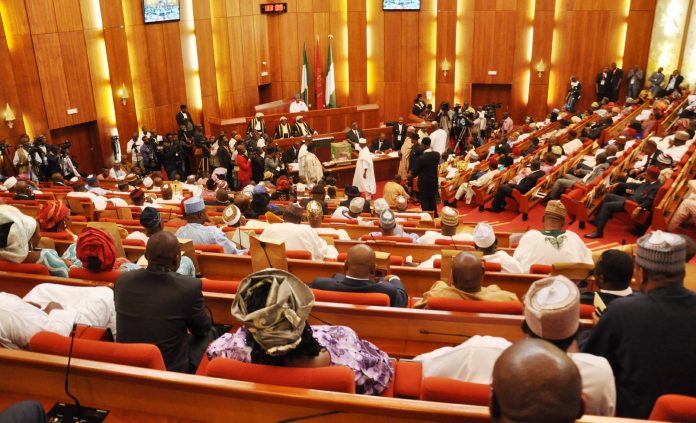
Nigeria’s upper legislative chamber, the Senate, has passed for third reading a bill seeking to strengthen regulatory oversight of Nigeria’s rapidly expanding financial technology sector by empowering the Central Bank of Nigeria (CBN) to regulate major fintech companies and other non-bank financial institutions in the country.
The proposed amendment to the Banks and Other Financial Institutions Act (BOFIA) 2020 seeks to empower the apex bank to designate qualifying financial technology operators and other non-bank financial institutions as Systemically Important Institutions (SIIs), subjecting them to enhanced regulatory supervision.
Specifically, the bill, SB. 959, titled ‘A Bill for an Act to Amend the Banks and Other Financial Institutions Act, No. 5 of 2020, to Provide for the Designation, Registration and Enhanced Supervision of Systemically Important Institutions; and for Other Related Matters’, was passed by the upper legislative chamber on Tuesday after clause-by-clause consideration at the Committee of the Whole House.
In line with legislative rules, the Chairman of the Senate Committee on Banking, Insurance and Other Financial Institutions, Sen. Adetokunbo Abiru, who sponsored the draft legislation with the committee members, presented the committee’s report during plenary presided over by Senate President Godswill Akpabio.
- Advertisement -
Under the proposed legislation, the apex bank will be empowered to identify and designate qualifying non-bank financial institutions as systemically important based on factors such as their size, transaction volumes, customer base and interconnectedness with the wider financial system.
The draft BOFIA 2020 amendment bill provides for the establishment of an official register of designated institutions and for stricter regulatory requirements covering corporate governance, cybersecurity, technology risk management, operational resilience as well as stress testing, data integrity assessments, enhanced regulatory reporting, and supervisory access to relevant information and operational systems of designated institutions.
The draft amended legislation also seeks to strengthen beneficial ownership disclosure, improve transparency in ownership and control structures, and establish enforcement mechanisms and sanctions for institutions that violate regulatory requirements.
The proposed amendment is designed to address emerging vulnerabilities in Nigeria’s financial services industry, particularly the growing influence of large fintech service providers whose operations have become increasingly interconnected with the nation’s conventional banking system.
The committee Chairman maintained that the proposed legislation had secured broad support from regulatory authorities, government agencies, financial institutions and professional bodies during a public hearing conducted on March 4, 2026.
According to the lawmaker, the apex bank supported strengthening the statutory framework for supervising systemically important non-bank financial institutions, particularly large fintech operators whose transaction volumes, customer bases, and operational interconnectedness could have significant implications for financial stability
Similarly, he disclosed that Federal Competition and Consumer Protection Commission (FCCPC) also supported stronger oversight but emphasised the need to maintain a clear distinction between prudential regulation, competition enforcement and consumer protection, urging appropriate coordination between the apex bank and FCCPC to prevent duplication of regulatory responsibilities and ensure that the proposed framework promotes fair competition while protecting consumers.
Other institutions the lawmaker listed as having supported the BOFIA 2020 bill were Nigeria Deposit Insurance Corporation (NDIC), Nigerian Communications Commission (NCC), Ministry of Finance Incorporated, Federal Ministry of Industry, Trade and Investment, Bank of Industry (BOI) and Economic and Financial Crimes Commission (EFCC), just as seven banks and other financial institutions also supported the proposed amendment.
The committee, therefore, advised all stakeholders to support the proposed amendments and other measures to strengthen financial stability, encourage responsible digital innovation, improve regulatory coordination, promote operational compliance and protect users of financial services.
It explained that a stakeholder-inclusive legislative approach was adopted during a public hearing on the bill to ensure that the proposed amendment reflected the concerns and recommendations of relevant institutions and members of the public.
The proposed amendment to the BOFIA 2020 is coming amid the rapid expansion of digital financial services in the country, with fintech operators playing significant roles in the rapidly evolving digital payment system.




