

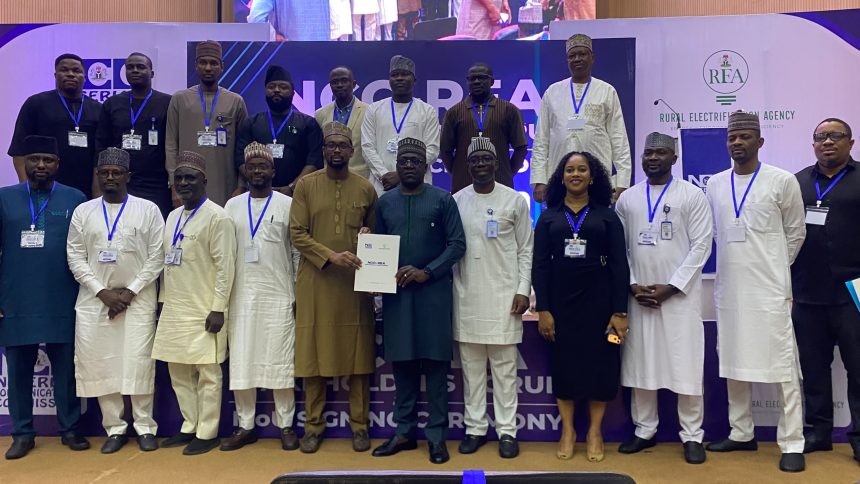
In a collaborative step toward deepening digital inclusion and energy access nationwide, the Nigerian Communications Commission (NCC), and the Rural Electrification Agency (REA), have signed a Memorandum of Understanding MoU, to enhance the deployment of telecommunications and electricity infrastructure in underserved rural communities.
The deal was sealed by the two agencies at a stakeholders’ workshop with the theme “Unlocking the Energy-Telecoms Nexus for Scalable Digital Infrastructure in Nigeria,” which had representatives of government agencies, telecommunications operators, renewable energy developers, tower companies and financial institutions in Abuja.
According to the MoU, part of the objectives of the parties is to improve coordination between Nigeria’s telecommunications and energy sectors by integrating infrastructure planning, sharing geospatial data and jointly implementing projects aimed at reducing deployment costs and improving service delivery in rural and unserved communities.
At the forum, the Executive Vice Chairman/CEO, of the NCC, Dr. Aminu Maida, who spoke shortly after the signing of the MoU, noted that reliable electricity and digital connectivity constituted complementary pillars of economic development as neither can deliver its full benefits without the other.
- Advertisement -
The telecom industry expert said: “When communities have access to reliable broadband connectivity, they gain opportunities for education, healthcare, financial inclusion and economic participation.”
Noting that telecommunications infrastructure requires dependable power to operate efficiently, while electrified communities cannot fully leverage modern digital services without reliable internet connectivity, Maida maintained that the partnership would enable both agencies to align infrastructure investments through coordinated planning and data sharing.
Specifically, in the agreement, the REA will provide the NCC with geospatial information on existing, planned and newly electrified communities, including mini-grid projects and solar home system clusters, while the NCC will share data on current and planned projects under its Universal Service Provision Fund USPF, to help identify communities lacking both electricity and telecommunications services.
According to him, the objective is to ensure that both agencies work from a common map of Nigeria’s connectivity and energy gaps, enabling more efficient deployment of infrastructure.
Speaking on the partnership, the commission’s Executive Commissioner for Technical Services at the NCC, Engr. Abraham Oshadami, said the collaboration would help improve network availability by connecting telecommunications base stations to renewable energy infrastructure in areas without access to the national electricity grid.
He explained that the agencies would identify mobile base stations located near existing or planned mini-grids, allowing operators to draw electricity from nearby renewable energy installations, stressing that the “approach will ensure that telecommunications base stations remain operational even in off-grid communities, where renewable mini-grids can provide a reliable source of electricity.”
Oshadami expressed optimism that the initiative would improve mobile and broadband coverage in rural Nigeria while supporting broader socio-economic development through increased access to digital services.
In his speech, the Executive Director, Technical Services of the REA, Umar Umar, said the MoU formalized collaboration between two agencies as they had long pursued similar development objectives independently.
According to him, the partnership will focus on data sharing, joint infrastructure mapping and coordinated implementation of projects designed to maximize the impact of public investment.
Umar further clarified: “The NCC and REA have established a joint technical committee to identify priority communities and develop pilot projects that integrate renewable energy with telecommunications infrastructure.
“We are combining our telecom coverage maps with electricity access data to identify locations where investments from both sectors can complement one another. The outcome will be data-driven pilot projects that provide practical models for future nationwide deployments”, he added.
Experts believe that the partnership has the potential to reduce infrastructure deployment costs, improve operational efficiency and accelerate the expansion of broadband and electricity services to millions of Nigerians living in underserved and unserved communities.
The NCC-REA initiative aligns with the Federal Government’s broader digital economy and energy transition objectives by promoting integrated infrastructure planning, renewable energy adoption and expanded digital access at the grassroots.




