

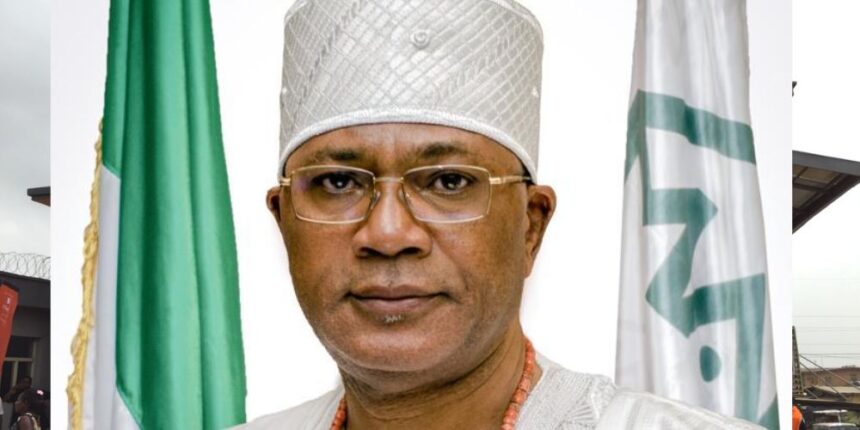
With the whirlwinds triggered by sundry fiscal and monetary policies remaining unabated all through last year in the economic landscape, the Manufacturers Association of Nigeria (MAN) on Tuesday reported that industrialists in the country recorded over N1.4 trillion worth of unsold goods.
The President of the manufacturers’ association, Chief Francis Meshioye, who gave this figure in his speech at the 9th Edition of the MAN’s Media Personality Award, attributed the unsold goods and the declining contribution of the sector to the nation’s GDP to sundry factors that significantly hampered production, sales, profitability of real sector companies and their overall contribution to the economy.
Specifically, he listed some of the major micro and macroeconomic challenges faced by real sector and other operators during the year as including high inflation, surging energy costs, and declining purchasing power.
The industrialist said: “Inflation, which peaked at 34.6 per cent in November 2024, was central in reducing consumer demand and weakening purchasing power, resulting in substantial unsold inventories.
- Advertisement -
“The sharp rise in the cost of goods led many Nigerians to prioritise necessities, further shrinking the demand for manufactured products and diminishing the sector’s GDP contribution”, he added.
In addition, Meshioye identified the devaluation of the Naira as a critical factor in the sector’s struggles as the local currency depreciated from N666/USD1 in mid-2023 to over N1700/USD1 by mid-2024.
He lamented that local currency’s exchange rate instability increased the cost of importing raw materials and machinery, further squeezing manufacturers’ profit margins and reducing their ability to produce competitively.
In addition, the industrialist pointed out that another challenge manufacturers faced in 2024 was the soaring cost of borrowing, with interest rates reaching a record 27.7% in November, adding that the prohibitive cost of credit curtailed manufacturers’ ability to finance operations, expand capacity, or modernise facilities, stagnation and further constrained the sector’s GDP contribution.
He also spoke on the energy costs which surged in 2024, with electricity tariffs increasing by over 250%, thereby compelling many manufacturers “to explore alternative energy sources, which strained financial resources and reduced operational efficiency. The rising energy costs, with an inconsistent power supply, exacerbated manufacturers’ challenges, limiting their capacity to compete locally and internationally.”
Meshioye maintained that despite these challenges, expressed optimism about the sector’s growth potential in 2025, projecting a gradual rebound in GDP contribution to between 13% and 14% by the end of the year.
On what needed to be done to improve the real sector’s contribution to the nation’s GDP, he emphasized the need for the monetary authorities to stabilize the Naira FX rate, even as he commended the Central Bank of Nigeria’s (CBN) for the introduction of the Electronic Foreign Exchange Matching System (EFEMS) in late 2024, which he believes will help stabilise the FX market.
According to him, if effectively managed, the EFEMS could stabilise the Naira within the range of N1,500/USD1 to N1650/USD1 in the first quarter of 2025 and alleviating some of the cost pressures associated with imported inputs by manufacturers.
On transformative role of technology in revitalising the manufacturing sector, the MAN President canvassed the need for greater investment in artificial intelligence (AI) and automation in order to enhance production efficiency, optimise capacity utilisation, and modernise supply chains.
While stressing that these policy and funding measures are critical for restoring the sector’s competitiveness and increasing its contribution to GDP, Meshioye appealed to the Federal Government to address critical policy and infrastructure deficit issues, stressing that inconsistent policies have deterred investment in the sector.
He also advised the fiscal authorities on swift implementation of the tax reforms and a downward review of electricity tariffs to reduce industrialists’ funding challenges.