
…Infrastructure Vandals Should Be Sanctioned – Attorney-General
The Executive Vice Chairman (EVC) of the Nigerian Communications Commission (NCC), Dr. Aminu Maida, has harped on the critical role Attorneys-General in the country can play in enhancing the current drive to improve digital inclusion in the country.
In his paper delivered at the 1st Annual Workshop for Attorneys-General on Emerging Issues in the Communications Sector on Wednesday in Lagos, the EVC said the forum represented a significant milestone by the commission in its sustained efforts in fostering collaboration between the legal community and the nation’s communications regulatory ecosystem.
Maida commended the Attorney-General of the Federation and Minister of Justice, Chief Lateef Fagbemi, SAN, for attending the workshop, noting that his presence represents a signal about the Federal Government’s commitment to institutional synergy and coherent policy development.
- Advertisement -
According to him, the theme of this workshop ‘Building and Driving Synergy in Regulating Communications for the Digital Transformation of Nigeria’ reflects the commission’s conviction that collaboration is not optional, but essential to the digitalization initiative of the government.
Maida maintained that no sector, particularly one as dynamic and impactful as communications, can be effectively regulated in isolation as the sector remains a vital enabler of innovation, commerce, governance, and social inclusion.
He said: “The communications sector remains a vital enabler of innovation, commerce, governance, and inclusion. However, to fully unlock its potential, we must tackle a range of challenges that cut across legal, regulatory, fiscal, and operational domains.
“This is where your role, as Attorneys-General, becomes critical. You are not only the Chief Law Officers of your states; you are also policy influencers and key partners in shaping the legal frameworks that support national development. Your insights and guidance help ensure that innovation happens within a structure that promotes fairness, accountability, and long-term stability.
“Since the early 2000s, communications regulation has evolved through distinct phases—from liberalising markets and establishing independent regulators, to expanding broadband infrastructure and fostering universal access. In the 2010s, attention shifted to protecting consumers, enabling digital financial services, and addressing crosssectoral challenges.
“Today, regulators are focused on advanced frontiers such as AI governance, digital resilience, and sustainable connectivity. Throughout this journey, one constant remains: collaborative, forwardlooking regulation is essential to sustaining innovation and inclusive digital growth”, Maida added.
Specifically, he explained that the workshop was organized to address several pressing issues in the sector today, including Reviewing the Nigerian Communications Act (2003) by assessing its strengths, weaknesses, and the need for reform to ensure its relevance in the digital age; streamlining taxation in the sector to address the burden of multiple and inconsistent taxes that hinder investment and sectoral growth; Resolving regulatory overlap with a view to enhancing coordination and eliminating inefficiencies caused by fragmented oversight.
In addition, the EVC emphasized the importance of implementing the 2024 Executive Order by President Bola Ahmed Tinubu, which designated communications infrastructure as Critical National Information Infrastructure (CNII), which provides a framework for deeper collaboration with the Office of the National Security Adviser and other key stakeholders.
Maida stressed that as Nigeria advances in its digital transformation agenda, driven by technologies like AI, IoT, and high-speed broadband, there was the need for Whole-of-Government approach that mobilizes the strengths of both federal and state institutions.
While assuring the commission’s readiness to work with the Attorneys-General to align regulatory actions with broader national goals, Maida expressed the belief that the chief law officers at federal and subnational levels “have a strategic role to play—not just in interpreting the law, but in shaping an enabling legal environment where technology and governance work in tandem.”
In his keynote address, the Attorney-General of the Federation commended the Commission for its foresight in pulling together the Chief Law Officers of the Federation together to engage and exchange ideas at the workshop with a view to identifying and bridging knowledge gap with respect to regulatory frameworks, and strengthening mechanisms for regulating communications in Nigeria as a panacea for digital transformation.
He noted that digital transformation remained critical to improvement in socio-economic development of a nation, adding that a well regulated communications sector implies enacting and implementing laws and regulations that ensure protection of rights including right to privacy, data protection and consumer rights as well as regulations that support the ease of doing business in Nigeria.
Justice Fagbemi explained that the justice and judicial sector were, therefore, critical components for regulating communications in Nigeria and inevitably entails upholding the rule of law by providing level playing fields for actors in the communications sector, preventing the exploitation of consumer rights through strengthening legal and regulatory frameworks and streamlining penal dispensation with a view to ensuring compliance with laws and regulations.
To achieve the digital transformation goal, the Chief Law Officer of the federation said “particular attention must be given to measures to curtail the destruction of infrastructure, by ensuring offenders are brought to book.”
While recalling the challenges in the communications sector, including the rising incidents of damages to critical infrastructure, the Attorney-General said it had, therefore, become “critical that the three arms of Government, as stakeholders cooperate and collaborate to address these issues and ensure improved regulation of the communications sector for enhanced socio-economic development.
“The legislature must review and strengthen laws that protect infrastructure and support the communications sector, while the executive reinforce measures aimed at implementing these laws. The judiciary is also a key stakeholder in ensuring offenders and saboteurs are made to face the full wrath of the law”, he added.
Photo Caption
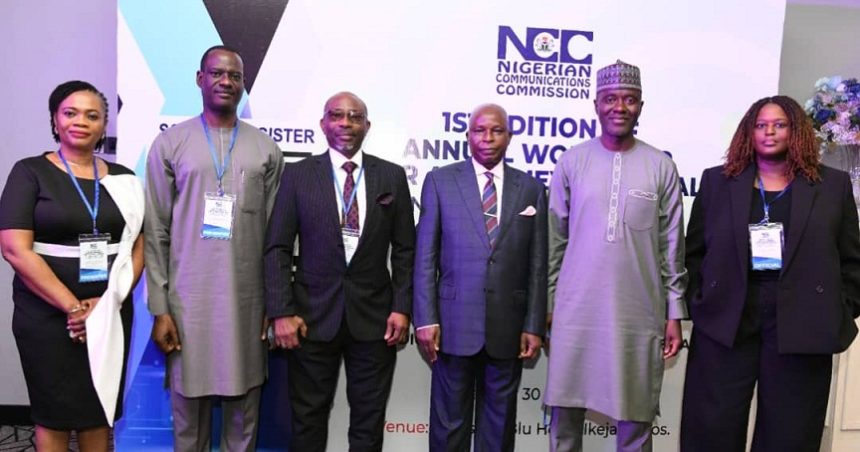
L-R: Head, Legal & Regulatory Services, Nigerian Communications Commission (NCC), Chizua Whyte; Chairman, Presidential Fiscal Policy and Tax Reforms Committee, Taiwo Oyedele; Attorney General of Lagos State, Lawal Pedro, SAN; Attorney General of the Federation and Minister of Justice, Lateef Fagbemi, SAN; Executive Vice Chairman/Chief Executive Officer, NCC, Dr Aminu Maida; and Executive Commissioner, Stakeholder Management, NCC, Barr. Rimini Makama, during the 1st edition of a two-day Annual Workshop for Attorneys General on Emerging Issues in the Communications Industry, hosted by the Commission which kicked off on Wednesday in Lagos