

…As NITDA Projects 59% Migration In 2027
The Central Bank of Nigeria (CBN) and the National Information Technology Development Agency (NITDA) have charged deposit money banks (DMBs) and other financial institutions (OFIs) to comply with its directive on local data hosting to complement its ongoing regulatory initiatives for effective data sovereignty and protection of the country’s economic and security interests.
The apex bank’s Director of Payments System Supervision, Dr Rakiya Yusuf, gave the charge last Thursday in his keynote address at the Seventh CIO & C-Suite Conference and Awards Africa event held in Lagos.
In her paper with the “Policy, Regulation and Data Sovereignty”, the banker explained the expansion of digital payments, e-commerce, cloud computing, artificial intelligence and platform-based services had made data governance increasingly critical to the nation’s economic development, hence the need for stronger oversight on the financial system.
- Advertisement -
According to her, to proactively respond to the emerging techno-powered digital system, Nigeria requires a trusted, inclusive and resilient digital economy capable of supporting innovation, attracting investment and delivering sustainable growth.
Yusuf recalled that in furtherance of the apex bank’s regulatory steps to secure the payment system it had issued a circular on June 15, 2026, directing financial institutions and participating payment facilitators to ensure that payment transaction data generated in Nigeria were stored and managed locally, in line with applicable data protection laws and regulations in the country.
Giving insight to the findings of a study conducted by the NITDA at the forum, the agency’s Director-General, Kashifu Inuwa, reported that 59 per cent of the 44 financial institutions covered by its recent survey analysis were expected to complete their migration by January 1, 2027, as regulators seek greater control over the digital infrastructure supporting Nigeria’s financial system.
The techno expert maintained that Nigeria needed the capacity to maintain essential digital services without totally depending foreign technological infrastructure and solutions.
During the presentation session of the survey findings, Special Adviser to NITDA’s Director-General, Dr Muhammad Aminu, disclosed that 39 per cent of the responding financial institutions confirmed that their systems covered by the requirements were fully hosted and managed locally, 22 institutions stated that were not yet implementing the data policy, while 29 were seeking further clarification on the requirements.
In addition, Aminu reported that the survey findings showed that 79 per cent of responding digital infrastructure providers were prepared to take new financial data, while 74 per cent could onboard new financial sector customers within three months.
Commenting on the findings, the NITDA boss said the findings reflected the difference between the readiness reported by infrastructure providers and the progress of financial institutions towards meeting the deadline.
Inuwa said Nigeria’s growing dependence on digital infrastructure had made it important for the country to have greater control over the technology supporting its economy, and told the
participants to image what could happen if a major submarine cable disruption or geopolitical crisis prevented Nigerian banks from accessing critical digital infrastructure hosted abroad.
Noting that a disruption could affect citizens’ ability to transfer money, businesses’ ability to receive payments and banks’ ability to process transactions, the Director-General explained that digital sovereignty was not about isolating Nigeria or building every technology locally, but about developing the country’s capacity to control the infrastructure on which its economy depended.
He said that NITDA was working in collaboration with the CBN to make Nigeria’s financial sector among the first to comply with the National Sovereign Cloud Initiative, adding that telecommunications companies, technology providers and other industry players will also be important to its implementation.
He hinted that the agency was developing an assurance framework and planned to adopt existing international certifications while exploring national certification options to give users more choices.
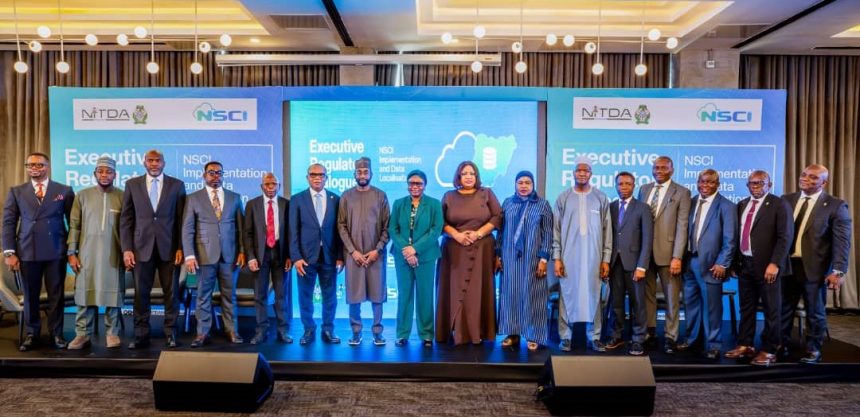
Photo Caption
The Director-General NITDA, Kashifu Inuwa; and CBN’s Director of Payment System Supervision, Mrs Rakiya Yusuf; in a group photograph with directors from the agency and apex bank during the Executive Regulatory Dialogue on NSCI Implementation and Data Localisation event held in Lagos




