
African Development Bank Group (AfDB) has reaffirmed its commitment to advancing Africa’s connectivity, industrialization, and regional integration through strategic investments aligned with Italy’s Mattei Plan and the European Union’s Global Gateway initiative.
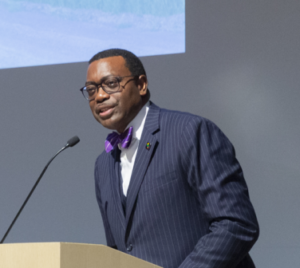
The AfDB Group President, Dr. Akinwumi Adesina, made the pledge while speaking at the joint Mattei Plan–Global Gateway Summit held on Friday 20 June in Rome, Italy.
The development banker maintained that the progress made by the AfDB in turning strategic priorities into action, particularly from infrastructure and energy to digital connectivity and value chains.
A news report from the African Press Organisation (APO) Group circulated on behalf of the bank, quoted Adesina as calling for greater alignment between partners and accelerated delivery on the ground, noting that the bank’s investments are already helping reshape regional trade and economic resilience.
- Advertisement -
He underscored for instance the Bank’s catalytic role in the Lobito Corridor, with $1 billion committed over five years for value chain development and urban infrastructure.
In addition, Adesina mentioned the development of the Tanzania–DRC–Burundi railway network, where the bank is helping to mobilize a $3.9 billion package alongside international partners, adding that the efforts reflect a coherent strategy to transform Africa’s economic geography through inclusive, green growth
Stretching from the Atlantic port of Lobito in Angola to the heart of the continent, the Lobito Corridor is a vital route for moving minerals, goods and people across Angola, Zambia, and the Democratic Republic of Congo—unlocking huge trade and industrial opportunities for landlocked countries.
These developments were highlighted as international partners gathered to align efforts around new cooperation frameworks, namely the European Union’s Global Gateway and Italy’s recent Mattei Plan, which aim to deepen investment with Africa in energy, agriculture, infrastructure, and digital innovation.
Adesina reaffirmed the bank’s role as a key implementing partner for both initiatives. The Mattei Plan, launched by Italy in 2024, is designed to foster equal partnerships with African countries, with a focus on strategic sectors including energy, agriculture, and migration. The Global Gateway, the EU’s €300 billion investment strategy, similarly targets infrastructure development worldwide, with €150 billion earmarked for Africa.
A cornerstone of this implementation is the operationalization of the Rome Process/Mattei Plan Financing Facility, which is a dedicated mechanism hosted by the Bank to accelerate climate-resilient infrastructure projects. The Facility’s inaugural Governing Council has already met and approved an initial pipeline of operations across energy, water, and transport sectors.
Adesina said: “We have established a Special Fund, and its inaugural Governing Council has already met to begin evaluating projects, including the Lobito Corridor.”
Underscoring the Bank’s leadership role in sustainable development of Sub-Saharan Africa (SSA), the banker recalled that the AfDB had invested more than $55 billion in infrastructure over the past decade, making it the largest financier of regional transport corridors in Africa.
Speaking at the forum, European Commission President, Ursula von der Leyen, reaffirmed the EU’s long-term commitment, stressing that “Global Gateway is an investment agenda that combines public and private capital… Africa is a continent of abundance—what’s missing is connectivity.”
Similarly, Italian Prime Minister, Giorgia Meloni, explained that “these are not top-down initiatives, but concrete projects shaped through dialogue and a shared desire for lasting development. The approach Italy has implemented is clear: respect, responsibility, vision.”
A key pillar of this transformation, Adesina noted, remained energy access, highlighting Mission 300, the joint African Development Bank—World Bank initiative to connect 300 million Africans to electricity and announced ongoing negotiations for a €165 million package with the European Commission to scale up renewable energy under the program.
He urged donors to support a robust 17th replenishment of the Bank Group’s soft loan arm for low-income countries — the African Development Fund – scheduled for this year, to sustain the momentum of the Mattei Plan and Global Gateway, stressing that “Together, let us do more with Africa.”
In a related development, the AfDB has signed a Letter of Intent with the Government of Zambia to advance the development of the Lobito Corridor, a transformative regional transport initiative connecting Southern and Central Africa.
The project entails the construction of approximately 550 km of railway from Chingola in Zambia’s Copperbelt to the Angolan border, as well as the upgrading of 260 km of road between Chisese and Jimbe via Mwinilunga.
The initiative builds on a broader Memorandum of Understanding between the Bank, Zambia, Angola, the Democratic Republic of Congo, and international partners including the United States, the European Commission, Italy, and the Africa Finance Corporation.
It aims to strengthen regional trade, improve transport infrastructure, and drive economic integration across the region.