

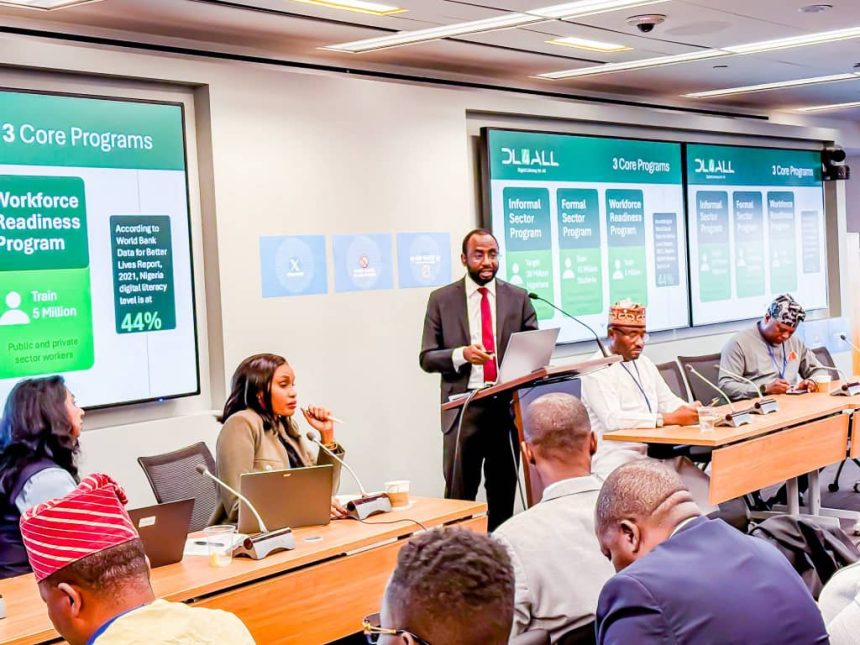
Director-General of the National Information Technology Development Agency (NITDA), Kashifu Inuwa, has underscored the importance of renewable energy and digital innovation in achieving inclusive growth and transforming rural communities across Nigeria.
Inuwa, in his contribution as a panelist at the Civil Society Policy Forum during the 2025 Annual Meeting of the World Bank Group and International Monetary Fund (IMF) in Washington, D.C., described renewable energy as a fundamental enabler for digital inclusion and economic empowerment.
He stressed: “Renewable energy is not the destination. It is a catalyst when there is power, connectivity follows, and that connectivity triggers true transformation.”
The technology expert explained how access to clean energy and technology can transform rural livelihoods with examples of AI-powered farming tools, online platforms for women entrepreneurs, and remote digital jobs that allow youths to earn globally while living locally.
- Advertisement -
For instance, he pointed out that a farmer equipped with a simple app can double his income, send his child to school, and employ others just as young person with internet access doesn’t need to migrate to Abuja or Lagos as he can work from his village and earn in dollars.
Linking some of the major innovations of the NITDA in the technology space to the Renewed Hope Agenda of the present administration, which prioritises sustainability, diversification, and inclusivity, Inuwa said Nigeria’s digital economy strategy under the Federal Ministry of Communications, Innovation, and Digital Economy rests on five key pillars, including knowledge, policy, infrastructure, innovation, and entrepreneurship, and trade.
This is even as he clarified that the agency’s operational framework expands on eight strategic pillars, including digital literacy, research, cybersecurity, innovation, and strategic partnerships.
Also, he disclosed that NITDA, in collaboration with the Federal Ministry of Education, was integrating digital literacy into Nigeria’s school curriculum from kindergarten to tertiary levels, since digital competency is now a prerequisite for employment and promotion in the civil service.
Inuwa maintained that through the sundry initiatives, the NITDA aimed to train 50 million Nigerians by 2027, creating a skilled workforce to drive the nation’s digital transformation.
He said: “Our vision is clear, our journey is set, and our resolve is stronger than ever. We invite everyone to join us in building a digitally empowered and prosperous Nigeria.”
Also speaking at the session, Senior Operations Officer, Infrastructure at the World Bank Group, Fowzia Hassan, reaffirmed the multilateral finance institution’s commitment to expanding energy access across Africa through its ambitious Mission 300 (M300) initiative targeting 300 million new connections by 2030.
She said: “Access to energy has always been central to the Bank’s development agenda, but with M300, we’ve set a clear target, a deadline, and the resources to make it happen.”
Hassan explained that the initiative had consolidated efforts by the World Bank, IFC, and MIGA to strengthen regulations, attract private investment, and deploy innovative financing models such as blended finance and risk-sharing facilities to reach underserved communities.
Highlighting the gender dimension of energy access, the banker cited data from the International Renewable Energy Agency (IRENA), which reflected that women make up 32 percent of Africa’s renewable energy workforce, mostly in non-technical roles.
To improve on the scale, Hassan advocated the need for deliberate policies to enhance women’s participation in technical and leadership positions.
She maintained: “Women are vital consumers, producers, and decision makers in energy. Yet they face barriers ranging from finance to education and workplace exclusion.
“Creating a clean, inclusive, and just energy transition is not just about connecting homes, it’s about empowering people, especially women and youth, to drive Africa’s prosperity”, Hassan added.
She listed some of the World Bank-supported initiatives as including its partnership with the African Development Bank (AfDB) on National Energy Compacts, the DAIRS programme in Nigeria designed to mobilise over $1 billion for mini grids and solar systems, and the Women in Energy Network Africa (WEN-Africa), which has already facilitated jobs for 57 women, to create 4,000 energy sector jobs for women within three years.




