

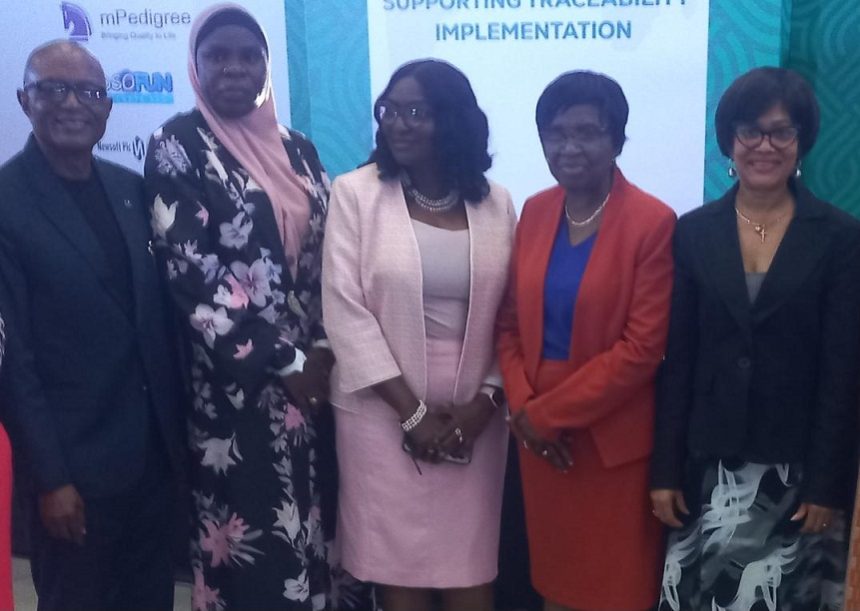
The National Agency for Food and Drug Administration and Control (NAFDAC) on Wednesday unveiled solution providers to support traceability implementation as the launching pad for a lasting transformation in the Nigeria’s pharmaceutical supply chain integrity.
The Director-General of the agency, Prof. Mojisola Adeyeye explained that the selected Solution Providers would support the implementation of the Phase II pilot of the agency’s private sector pharmaceutical product traceability, even as she recalled that NAFDAC had been on the public sector pilot for about five years since the advent of the COVID-19 Pandemic.
She said: “We are scaling it up from the narcotic products now to MNCH products. Today represents a significant step forward in our shared commitment to safeguarding public health, particularly around Maternal, Newborn, and Child Health, and Nutrition (MNCH&N) products.”
Speaking at the unveiling event in Lagos, the Director-General explained that ‘‘traceability is more than a regulatory requirement—it is a public health imperative.’
- Advertisement -
With the increasing threat of substandard and falsified medical products, especially within vulnerable populations, she reiterated that the need for a reliable and transparent pharmaceutical supply chain is paramount.
Adeyeye disclosed that the gazetting of NAFDAC’s Pharmaceutical Products Traceability Regulations in October 2024 signalled the agency’s unwavering resolve to harness technology to protect lives and enhance accountability across the health sector.
According to her, NAFDAC is the leading agency in Africa in the use of GS1 technology to make the supply chain visible, adding that the agency occupies the leading position in Africa and in other parts of the world.
She clarified: ‘Turkey started before us. It’s something that we should be proud of,’ she said, noting that it might have caused some inconveniences here and there, but that is part of what it takes to build a legacy project. Phase 11 Pilot is a collaborative effort, and it’s designed as a scalable pilot for MNCH”
Describing the Phase 11 pilot as a joint effort and designed as a scalable pilot for MNCH&N commodities to last for 12-months in the first instance, the NAFDAC boss pointed out that it would only thrive on strong collaboration by all stakeholders. Discussion is underway with manufacturers on how to optimize the pilot for least inconvenience.
She expressed deep gratitude to the Marketing Authorization Holders’ (MAHs’) representatives, describing them as visionary and mission driven for seeing Nigeria in the next 10 years.
Adeyeye emphasised that their cooperation to participate and work closely with their assigned Solution Providers is not only required but also crucial in laying the foundation for national scale-up across all other product categories.
She also appreciated the Solution Providers as she recognized the value they bring, noting that their technical expertise and commitment to interoperability will play a central role in demonstrating that traceability is achievable, efficient, and impactful within our local context and across national borders.
She admonished all stakeholders—regulatory, technical, and industry—to approach this pilot with urgency and shared purpose, adding that they should ensure timely product identification and data sharing with NAFDAC, using GS1 standards, integrate their systems, and actively engage in providing feedback.
Earlier in his welcome address, the Special Assistant to Director-General and Head of the NAFDAC Traceability Office, Dr Gbenga Fajemirokun, recalled that the agency launched the phase I of the implementation of the Traceability Strategy document on January 18, 2024, a very important step towards securing the pharmaceutical supply chain.
Explaining that the phase I of the track and trace project is designed to monitor a select group of narcotic products throughout the supply chain, the Director-General’s aide noted that pharmaceutical supply chains needed visibility to ensure product integrity, security, and timely delivery, especially due to the sensitive nature of medicines and the strict regulations involved.
This even as he maintained that increased visibility allows for better management of disruptions, improved quality control, and reduced costs associated with temperature excursions, adding that ultimately, enhanced visibility strengthens patient safety and trust in the pharmaceutical industry.
He said Substandard and Falsified (SF) medical products posed a significant public health risk, making supply chain visibility crucial for ensuring patient safety, adding that these products, which include medicines, vaccines, and medical devices, can be ineffective, harmful, or even fatal.
According to Fajemirokun, the supply chain visibility helps in tracking and tracing products from manufacturer to patient, enabling the identification and removal of SF products from the market.
With GS1 as technical partner, the solution providers include SPROXIL, Chekkit, Afrihealth, Newsoft MSP, PharmaSecure, Adsofun and mPedigree.
Photo Caption
L-R: Special Assistant to Director-General National Agency for Food and Drug Administration and Control (NAFDAC) and Head, Traceability Office, Dr. Gbenga Fajemirokun, the agency’s Director, Vaccine Biologics and Medical Devices Registration and Regulation (VBM-R&R), Mrs. Oluwakemi Ade-Abolade; Managing Director/Principal Consultant, Fensyl MHP Consulting Limited, Mrs Osareti Jaiyeola; Director- General NAFDAC, Prof. Mojisola Adeyeye, and Director Food Safety and Applied Nutrition (FSAN), Mrs. Eva Edwards, at the unveiling of Accredited Solution Providers supporting Traceability Implementation by the agency on Wednesday in Lagos




