

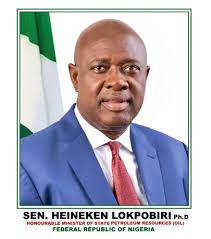
The Minister of State for Petroleum Resources (Oil), Sen. Heineken Lokpobiri, has hinted that Nigeria would demand a higher oil production quota at the next meeting of the Organisation of Petroleum Exporting Countries (OPEC) scheduled to hold in November.
The minister made this disclosure on Tuesday in Abuja during an interview with the media team of the Nigerian Upstream Petroleum Regulatory Commission (NUPRC), when he reviewed Nigeria’s upstream oil sector performance after the enactment of the Petroleum Industry Act (PIA) 2021 and the establishment of the Commission.
According to him, the country’s current quota now pegged at about 1.5 million barrels per day (mb/d) by the oil cartel no longer reflects Nigeria’s actual production capacity.
Lokpobiri maintained that the upcoming OPEC’s meeting would avail Nigeria the opportunity to canvass an upward review to at least two million barrels per day.
- Advertisement -
According to him, the upcoming OPEC meeting provides an opportunity for Nigeria to make a strong case for an upward review to at least two (mb/d).
The minister explained: “The OPEC quota is subject to periodic review, and by November, when we attend the annual meeting, we will certainly be making a case for a higher quota for Nigeria. And I believe that there’s no better time than now for us to make a strong case for Nigeria’s quota to be reviewed to two million and above.”
While expressing optimism that Nigeria’s improved output levels, stronger infrastructure, and growing investments in the upstream sector would support the country’s case for an increase, Lokpobiri pointed out that the sustained recovery in production, improved regulatory environment, and improving FDIs inflow into the oil and gas sector had justified Nigeria’s position to demand for a higher oil quota at the OPEC’s scheduled meeting.
He recalled that when he became minister, the OPEC quota for Nigeria was 1.5 million barrels per day because the nation’s production then was below that level, adding that but today Nigeria is producing around 1.7 million barrels daily, including condensates, and has the capacity to produce above two million barrels per day, hence the need to review the quota upward.
The minister explained that Nigeria’s actual output included condensates, a lighter, higher-value form of crude not covered by OPEC’s production limits and that this gives the country flexibility without violating its quota.
He clarified: “Condensate is not counted in OPEC production, yet it sells at a higher price,” he said. “If we do 1.5 million barrels of crude and one million barrels of condensate, we are still within the rules. And because we have capacity, we are also going to show that we have capacity. Right now, there is something going on to assess our capacity, and that assessment is currently going on. And we believe that we will show the world that we have the capacity to produce more than two million barrels.”
Lokpobiri attributed the improved crude oil and condensates production to improved security and better pipeline integrity across the Niger Delta, noting that before now, companies are scared to produce because crude pumped into pipelines hardly gets to the terminals.
The minister lamented that several years of pipeline vandalism and oil theft undermined Nigeria’s production capacity, but that recent policy interventions by the government and security agencies’ community partnerships had reversed the ugly trend.