

The International Labour Organization (ILO), together with the Global Partnership for Universal Social Protection (USP2030), launched a global initiative under the Sevilla Platform for Action on the sidelines of the 4th International Conference on Financing for Development (FfD4) held in Savilla, Spain.
A statement from the ILO indicated that the initiative aimed at expanding the fiscal space for social protection with a view to extending social protection coverage by at least 2 percentage points per annum in countries where social protection is not yet universal.
The UN member-states reflected this commitment in paragraph 27i of the FfD4 Outcome document at the forum.
In her opening remarks at the event, Professor of Economics at the University of Massachusetts Amherst, USA, Jayati Ghosh, emphasized that in a world where austerity cuts are threatening social expenditure, securing a concrete commitment to expanding social protection coverage is a significant achievement.
- Advertisement -
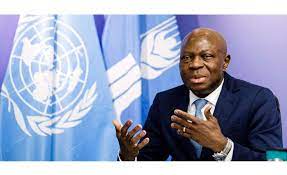
The ILO Director-General Gilbert F. Houngbo highlighted how critical it remained to aim for increasing social protection coverage by at least 2 percentage points each year, at a time when 47.6 percent of the world’s population still has no social protection at all to fall back on when they get sick or lose their job.
He maintained that “don’t say this target is unachievable or too ambitious”, and that between 2015 and 2023, 42 countries, mostly developing countries, were able to achieve annual growth rates in social protection coverage of at least 2 percentage points per year.
Similarly, South Africa’s Minister in the Presidency for Planning, Monitoring and Evaluation and Chair of the G20 Development Working Group, Maropene Ramokgopa, endorsed the commitment, emphasizing that social protection benefits are not simply an expense but an investment in human capital.
She also underlined that progressive taxation, the tackling illicit financial flows, and managing and restructuring of sovereign debt must be at the heart of any plan aiming to expand the fiscal space for social protection.
In his remarks, Brazil’s Minister of State for Social Development and Assistance, Family, and the Fight Against Hunger, Wellington Dias, emphasized the dual role of progressive taxation in both reducing inequality and helping governments finance social protection.
He also endorsed the target of increasing social protection coverage by 2 percentage points and highlighted that President Lula’s Global Alliance Against Hunger and Poverty will be key for achieving this target.
The Government of Uzbekistan representative also stressed that the UN Global Accelerator on Jobs and Social Protection for Just Transition, especially through its roadmaps, represented another concrete vehicle to provide the needed technical support to expand the fiscal space for social protection to extend coverage by at least 2 percentage-points.
The target of expanding social protection coverage by at least 2 percentage points was also welcomed and endorsed by the International Trade Union Confederation (ITUC).
Commenting on the initiative, ITUC TUDCN Coordinator, Giulia Massobrio, said: “Social protection is a vital pillar of our call for a New Social Contract. It has also been an essential demand of the ITUC in the UN financing for development for many years.”
She also emphasized that to achieve decent work for all, it is essential to combine social protection with other measures, such as formalizing employment, ensuring living wages, equal pay for work of equal value, supporting upskilling and reskilling, and investing in the care economy.
While the Global Coalition for Social Protection Floors supported the 2-percentage-point target, it pointed out that it was not ambitious enough to achieve universality by 2030, nor does it address the adequacy of benefits.
In response, ILO Director-General said: “The 2-percentage-point minimum target secures a clear place for the ILO’s social protection agenda in the FfD4 outcome document for the next 10 years.
“But let me assure you: when the ILO engages at the country level, we look far beyond simply raising coverage by 2 percentage points. We work to strengthen the entire social protection system – making sure benefits are also truly adequate to meet people’s needs”, the labour expert added.




