

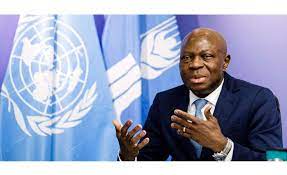
The Director-General of the International Labour Organization (ILO), Gilbert F. Houngbo, opened the organisation’s 113th International Labour Conference on Thursday in Geneva, Switzerland, by reaffirming the strategic importance of its mandate in a world of work undergoing profound transformation.
In his opening address delivered at the event, the labour expert maintained that the ILO’s normative mandate was becoming more relevant than ever, saying that the “role includes not only the development, implementation and supervision of international labour standards, but also the urgent need to ensure a level playing field in an increasingly interconnected and rapidly changing global economy.”
The Director-General also stressed the organization’s role in advancing social justice through integrated policies, adding that “we can and must act with determination and consistency to promote social justice through a better balance between economic, social and environmental dimensions.”
Houngbo acknowledged that multilateral institutions like the ILO are facing a period of profound change. While recognizing the uncertainty surrounding the future of multilateralism, he cautioned against nostalgia for an idealized past.
- Advertisement -
He explained: “We must instead remain firmly focused on the ILO’s unique purpose as set out in its Constitution, and the lasting contributions it has made globally,” he said. “As an institution, we must have the courage, humility, ability to listen and adapt, and the foresight to look resolutely to the future. This context calls for reform – reform for greater effectiveness, but also for greater efficiency.”
Similarly, he also highlighted that slower global growth and rising trade tensions are putting pressure on job creation, stressing that “employment is not a passive result of economic growth – it must be an active part of it” and called for stronger links between job creation, workers’ protection, and inclusive, democratic development.
The ILO annual conference brings together worker, employer, and government delegates from the ILO’s 187 Member States to address a wide range of issues that have a long-term impact on the world of work.
The agenda includes Biological hazards at work – second discussion on proposed standards; Decent work in the platform economy – first standard-setting discussion; and Draft Programme and Budget for 2026–27 – review of proposed expenditure, contributions, and financial statements.
Others are, Transition to formality and decent work – general discussion on innovative approaches; Application of international labour standards 2025 – Information and reports on the application of Conventions and Recommendations; Social Development Summit 2025 – tripartite input on the ILO’s contribution; and Maritime Labour Convention – approval of the 2025 amendments to the Code of the MLC.
The second Global Coalition for Social Justice Annual Forum is scheduled to hold on Thursday, 12 June 2025, bringing together Coalition partners and accredited ILO tripartite delegations attending the Conference.
On the first day of the Conference, Minister of Public Service Labour and Social Welfare of Zimbabwe, Edgar Moyo, was elected President of the Conference while Minister of Labour and Social Security of Uruguay (Governments), Juan Castillo, (Employers) from Senegal, Hamidou Diop; and (Workers) from Tunisia, Hédia Arfaoui; emerged Vice-Presidents.
The 113th International Labour Conference, which is being held in Geneva, will be concluded on the13th of June