
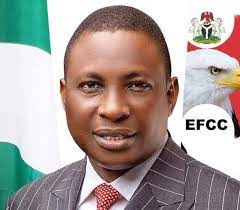
The Economic and Financial Crimes Commission (EFCC), reported on Thursday that it had recovered over N566 billion, $411 million, and 1,502 properties in the last two years in its sustained drive to frontally tackle all forms of economic and financial frauds in the country.
The anti-graft agency’s Director of Public Affairs, Wilson Uwujaren, made the disclosure in Abuja at a media briefing t mark the second anniversary of the EFFC Chairman, Mr. Ola Olukoyede, in office.
Uwujaren, who represented his boss at the event, quoted him as saying that the commission has made unprecedented progress in its fight against economic and financial crimes across all fronts during his tenure.
According to him, between October 2023 and September 2025, the commission received over 19,000 petitions, conducted 29,240 investigations, filed 10,525 cases against suspects in courts, and secured 7,503 convictions.
- Advertisement -
Olukoyede clarified: “The commission in the same period recovered ₦566,319,820,343.40, $411,566,192.32, £71,306.25, €182,877.10, and other foreign currencies from proceeds of financial and economic crimes.
“It also recovered 1,502 non-monetary assets, comprising 402 properties in 2023, 975 in 2024, and 125 so far in 2025.
“Among these recovered assets are two notable landmarks: the final forfeiture of 753 units of duplexes in Lokogoma, Abuja, and the forfeiture of Nok University, now the Federal University of Applied Sciences, Kachia, Kaduna State”, he added.
He listed some of the anti-graft agency’s major cases prosecuted during the period as those involving former governors Willie Obiano, Abdulfatah Ahmed, Darius Ishaku, Theodore Orji, and Yahaya Bello, as well as those that affected former ministers Olu Agunloye, Mamman Saleh, Hadi Sirika, and Charles Ugwu, and former Central Bank Governor, Godwin Emefiele.
Olukoyede also disclosed that the commission also re-opened many lingering corruption cases involving Fred, Ajudua; former Chairman of PDP, Haliru Bello Mohammed; ex-National Security Adviser, Sambo Dasuki; former NSITF Managing Director, Ngozi Olojeme; among others.
He recalled that in December 2024, the commission arrested 792 suspects in connection with investment and cryptocurrency fraud in Lagos, including 192 foreign nationals who were later prosecuted and deported, adding that the arrests send a strong message that Nigeria will not allow its territory to be turned into a safe haven for cybercriminals.
The EFCC chairman disclosed that part of the recovered funds had been channeled into some national programmes, including the Students Loan Scheme and Consumer Credit Scheme, with a total of N100 billion invested so far on such programme while agencies such as the Niger Delta Development Commission (NDDC), Asset Management Corporation of Nigeria (AMCON), Federal Inland Revenue Service (FIRS), and National Health Insurance Authority (NHIA) — also benefited from remitted funds to the national treasury.
Similarly, Olukoyede disclosed that some of the recovered properties were allocated to government agencies for use as offices in line with the Commission’s policy of ensuring that recovered assets are put to productive use; and spoke about the Task Force on Naira Abuse and Dollarisation of the Economy, an initiative, he said, had helped sanitize the foreign exchange (FX) markets and reduce speculative pressure on the naira.
He highlighted the commission’s dual approach to fighting cybercrime through enforcement and prevention, recalling the National Cybercrime Dialogue held in January 2024, and the National Cybercrime Summit in October 2024, during which the First Lady, Oluremi Tinubu, unveiled the Cybercrime Response Centre.
This is even as he maintained that the EFCC had deepened international partnerships with agencies such as the FBI, UK’s National Crime Agency (NCA), INTERPOL, and Japan’s JICA, resulting in joint investigations and repatriation of stolen assets to victims in Spain, Canada, and the United States.
He expatiated: “In 2024, we had the honour of hosting Christopher Wray, former FBI Director, and the Director General of the NCA, Graeme Biggar, a testament to the global respect the EFCC commands today,” he said.
At the sub-regional level, Olukoyede’s leadership as President of the Network of National Anti-Corruption Institutions in West Africa (NACIWA) led to the establishment of a permanent secretariat in Abuja.
The EFCC Chairman maintained that corruption prevention remained the hub of the commission’s drive towards fully combating all forms of graft in the country.
He stressed: “Prevention is a more cost-effective approach than enforcement. That is why we established FRAC to deploy risk-based strategies in monitoring the budget performance of Ministries, Departments, and Agencies.”